Author: Amelia Taylor, also published on medium.
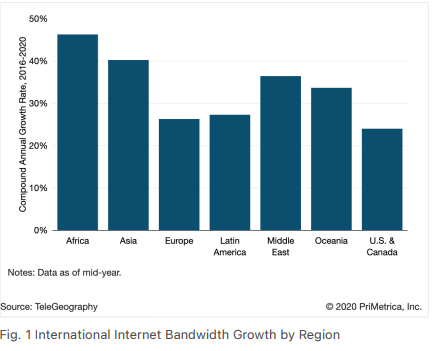
It is no doubt that internet access has become essential to research and technological and commercial development. Africa’s international bandwidth has been increasing, from 4.5 TBps in 2012 to 10.9 in 2018 and 15.3 in 2019. At the same time, Africa’s operational fiber optic network has also been expanded to over 1 million route km.
Malawi has also improved its access to the internet by expanding its fiber network internally and also its connectivity. A national fiber backbone has been built to connect all 28 districts in the country. Malawi now has direct access to capacity from Africa, instead of re-routing all connectivity needs through Europe or the US (which is expensive). This should improve access and reduce costs for fact internet in Malawi.
This article is not about internet access although this topic is very relevant for data centers and digital services including those using Machine Learning and for Data Science. Such applications and services access fast and reliable data storage and computing power. We are going to talk about data storage by looking at data centers in Malawi with a focus on the newly inaugurated National Data Center in Blantyre. Here
Malawi is also following a trend: according to Arizton Advisory and Intelligence, investment in the African data center market is expected to reach US$5.4billion by 2027.
What is a data center? What kind of services it offers?
A data center is a site hosting all of the systems necessary for the operation of IT applications. It comprises all of the software and hardware infrastructures used in the IT and non-IT spheres. The IT sphere covers servers, storage bays, and network equipment enabling both internal and external exchanges. The non-IT sphere covers equipment used for the management, production and distribution of power and cooling. The term data center refers to an IT site whose dimensions can vary considerably: from a room measuring a few square meters to over 10 000 m2. Data Centers house critical resources in controlled environments under centralized management which enables enterprises to operate around the clock or according to their business needs.
Virtually, every enterprise has one or more Data Centers. In Malawi, banks have their own datacenter, telecommunication companies such as TNM, utilities such as ESCOM, ISPs such as MRL, Inq (former Skyband) have their data centers, the Ministry of Health, and so on.
Data centers are complex and expensive things. A data center is always made
up of three fundamental components. The infrastructure, i.e. the space and the equipment needed to support the data center’s operations. This includes power transformers, power supplies, generators, air-conditioning units, power distribution systems, etc
- IT equipment comprising racks, servers, storage, cabling, system management tools, and network equipment
- Operating areas for the staff whose job it is to operate and, as necessary, maintain and repair the IT and non-IT systems.
Therefore, dedicated data centers can offer a scalable, economical solution to
both larger / richer organizations and smaller businesses including startups. The potential risks for a data center fall into two categories: internal risks e.g. malfunctioning of equipment, human errors, and external risk, e.g. failure in the power supply or internet connectivity issues
The National Data Center in Blantyre
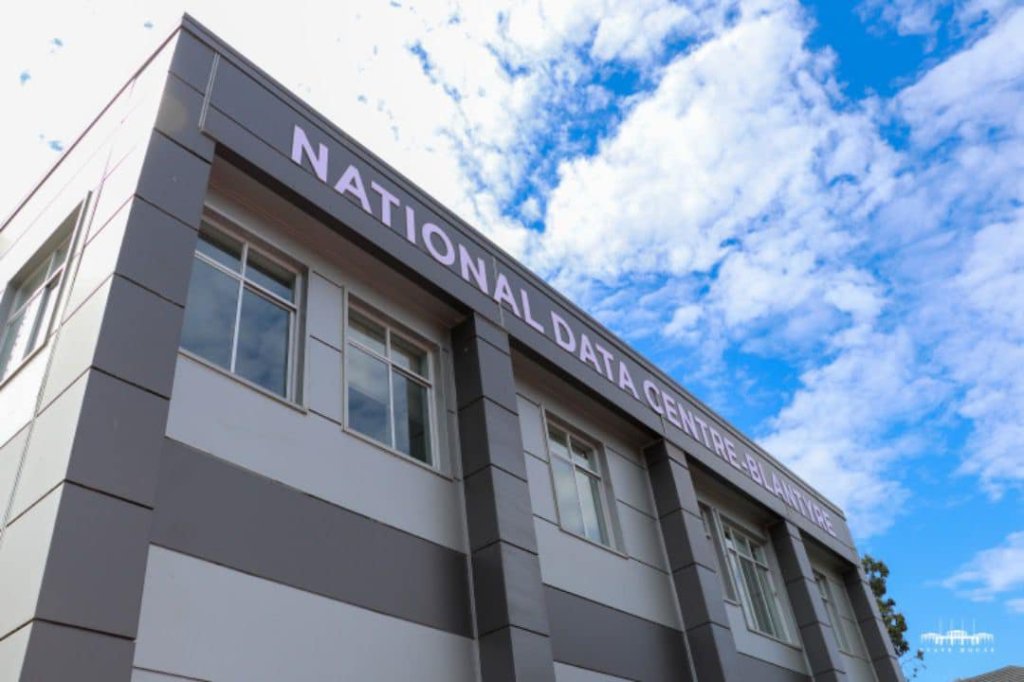
With these aims in mind, a new data center was opened by the President of Malawi, Dr. Chakwera, called “The National Data Center, Blantyre”. I went to see it and met with Nkhwachi P. Theu, Communications Engineer.
The National Data Centre is an initiative under the Malawi National Fiber Backbone Project which greatly expanded the fiber connectivity in Malawi by adding aerial optical cables to cover major cities in the country.
ESCOM was, as Mt. Theu told me, the natural company to implement and oversee this expansion because of its position as the major power generation and distribution player, and, unknown to many people, holding also a carrier of carrier and ISP licenses. The project was implemented by Huawei in conjunction with the Electricity Supply Corporation of Malawi (ESCOM). The National Fiber Backbone was installed by ESCOM using their existing power lines. All the equipment is Huawei.
In 2010, the National Fiber Backbone was stopped at Mzuzu which connected to the North via a Microwave backbone route using microwave receivers. Also, Malawi was not connected to the African infrastructure via direct links. Currently, Malawi has a functional route to Tanzania via Songwe and a route to Zambia via Lilongwe, and a route to Mozambique via Zobue. This hopefully will solve a challenges Malawi has been facing: that is to obtain international bandwidth capacity at low prices.
Through this initiative, ESCOM is expanding its business model. It can now lease the fiber optic capacity on its cables, and how that will play out in terms of other internet providers who are using their own or leasing dark fiber is the subject of another article.
Now coming back to our topic of data centers.
What is unique about the National Data Centre in Blantyre
(By the way, I did ask the question why it was called National and the answer was that it was meant to signify that it is available to everyone across the nation, rather than to emphasize that it is government owned.)
It is built to a 3-tier facility (the first in Malawi, which means an availability rate of 99.98%), and it is built to ensure maximum uptime and connectivity. It aims to target its services to both to government, education, and the private sector. I did wonder if SNDP will house its services here?
The data center can offer a flexible model: clients can use the equipment available there and manage all their data and services remotely via virtual connections. Clients may also choose to house their own equipment at the center where it will be managed and run.
I was given a tour by Mr. Theu inside the data center. I was taken through a large room housing only power equipment needed to sustain the data center and manage its power usage and stability. Then I was shown another large room holding the servers, with cooling equipment, and network security and monitoring equipment. It was all very impressive and the hope is that data
centers like this will indeed be utilized to develop digital services in Malawi.
At the moment, the facility is new, and it is yet to occupy its racks.
How can Malawi organizations, businesses, and start-ups use this infrastructure
This is not an easy question to answer now only time and experience will tell. What I learned from Mr. Theu is that normally in terms of internet bandwidth there is a lot of redundancy / hence capacity that can be shared. Similarly, in terms of digital services including those that incorporate ML, and data science applications there is a need for economical and reliable data centers is evident.
Of course, there is a matter of pricing, and on that, I did not get a pricing list, but Mr. Theu assured me that they are open to negotiation.
There is the other aspect, that is cloud computing which can allow one to build a virtual data center. How will the National Data Center compete with that? I asked Mr. Theu to give me an example of customers that will likely use their services in Malawi. Without entering into details the data center can open opportunities for:
- Virtualisation hence cost reduction
- Migration of older servers and their replacement with new servers
- Network storage solutions
- Commercial services that could be offered in the data center can be IaaS, PasS etc.
In terms of machine learning or applications using IoT or large-scale data analytics, a data center can provide the computing capabilities and data storage/access capabilities required at a more reasonable cost. On the other hand, ML is also used to manage complex data centers. You can
read an article about this here:
https://www.datacenterdynamics.com/en/
analysis/ai-in-the-data-center-still-a-work-in-progress-for-all-but-the-hyperscalers/
Conclusion
The visit to the National Data Center and the information we got from Mr. Theu have been an eye opener. There are opportunities in Malawi and the infrastructure to sustain them. Only the future will tell the value of data centers, AI, and ML in Malawi. This visit also touched on other topics, like, cost-effectiveness, competition in the internet market, issues of data security, legal frameworks, liability and regulation, and of course the skills market. These are all topics to be explored later on.
We are grateful to the National Data center, Mr. Chester M. Kabinda, and Mr. Nkhwachi P. Theu for their welcome and timely. We hope they will come to the IndabaX to share more valuable insights into this topic.
Also published on medium.
 Machine Learning Malawi
Leave a comment